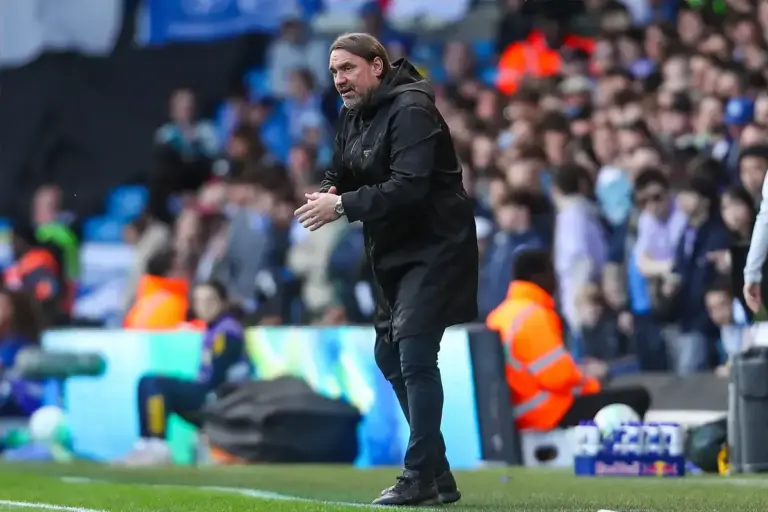
The Leeds United striker question is the one Daniel Farke has not been able to shake all summer, and with the window down to its final days it landed in front of him again on Friday. The Whites carry just two natural No.9s into the closing stretch — Dominic Calvert-Lewin and Lukas Nmecha — and the Leeds manager has now set out where he stands on adding a third.
Leeds United striker options: what Farke is actually working with
The Yorkshire Evening Post reported on Friday evening that Farke had assessed his centre-forward department and addressed the prospect of an extra striker signing before the deadline. The paper’s framing of the squad is the important part, and it is not in dispute: Leeds have two recognised No.9s, in Calvert-Lewin and Nmecha, with Noah Okafor and Wilfried Gnonto the alternatives who can be asked to lead a line without being built for it.
That is a thin top end for a Premier League squad about to play across three competitions. Calvert-Lewin, the No.9 in the literal sense, is the England-capped focal point signed to give Farke a genuine target. Nmecha, wearing 14, is the natural deputy. After that the picture blurs. Okafor and Gnonto are forwards who do their best work arriving into the box rather than occupying it, and Harry Wilson — a free transfer from Fulham and arguably the summer’s shrewdest bit of business — is a creator, not a spearhead.
How the squad got this light up front
None of this happened by accident. Leeds spent the summer deliberately clearing forward bodies out of the building. Joe Gelhardt joined Hull City in a £6.5m deal, ending a long and often frustrating Elland Road story. Joël Piroe, the club’s most reliable goalscorer of the Championship years, went out on loan. Sebastiaan Bornauw also left on loan, and Jack Harrison — another who could fill in across the front line — moved to New England Revolution.
Set against that, the incoming business has been weighted elsewhere. James Trafford arrived from Manchester City for £45m to solve the goalkeeping question, Tarik Muharemović came in from Sassuolo for £34m, Nico Elvedi joined from Mönchengladbach for £8.5m, and Wilson and Ditmir Hodja completed a rebuild that has strengthened almost every department except the one that scores goals. The confirmed 2026/27 squad numbers tell the story at a glance: a deep back line, a well-stocked midfield, and two No.9s.
Why the numbers matter more than the names
Depth is not an abstract concern in this squad. Calvert-Lewin came within a refereeing judgement call of missing chunks of the opening month at the City Ground, with former official Dermot Gallagher later explaining what saved the Leeds striker from a red card. Had that gone the other way, Farke would have been down to Nmecha and improvisation inside a fortnight.
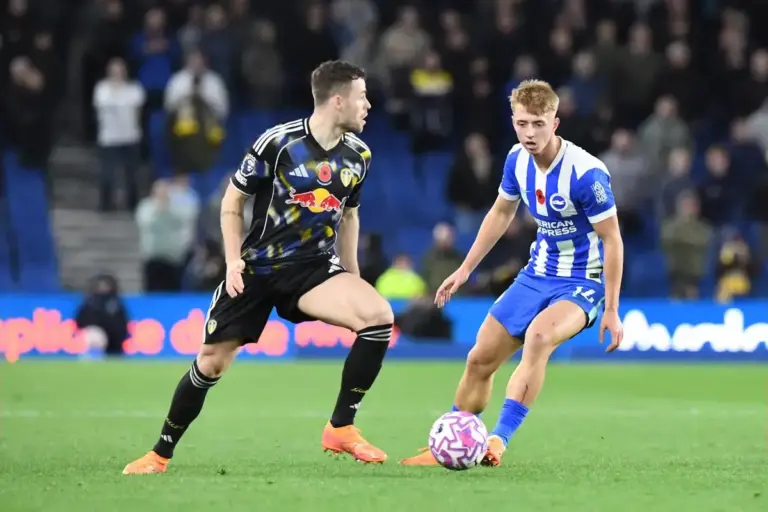
The fixture list does not help either. Leeds sit ninth after winning both of their competitive games so far — Anton Stach’s free-kick settling the Premier League opener 1-0 at Nottingham Forest on 22 August, then a 2-0 EFL Cup second-round win at the same ground three nights later. Brentford visit Elland Road on Sunday for the first home league game of the campaign, and a third-round Carabao Cup tie at Chelsea has now been slotted into the calendar. A squad carrying two centre-forwards through a Premier League season with cup football attached is running without a spare wheel.
Farke’s own history offers a clue as to how seriously he treats this. He is a manager who likes a clearly defined centre-forward and who builds patterns of play around one — wide players hitting the byline, midfielders arriving late, a No.9 holding the middle of a back four. That structure does not simply transfer to a front three of Okafor, Gnonto and Wilson, all of whom want to run into space rather than create it for others. Playing without a recognised nine is not a plan B for this Leeds side so much as a different sport.
The market Leeds are looking at
There is evidence the club know it. MOT Leeds News reported on Thursday that Leeds are pressing ahead with a move for Conrad Harder, with terms worth a reported £13.7m attached — a link this site covered when the Harder terms were revealed. That remains a report rather than a signing: nothing has been confirmed by Leeds or by the player’s club, and deadline-week valuations have a habit of shifting between outlets. Contrasting figures have already circulated for what may or may not be the same target.
What the reporting does establish is the shape of the club’s thinking — a forward in the low-to-mid teens in millions rather than a headline gamble at the top of the market. That is consistent with how Leeds have operated all summer, and consistent with Farke’s public posture, which has been to confirm nothing until it is signed. Supporters heard the same tone this week on the goalkeeping front, when the manager offered little more than a shrug about the club closing on Michael Zetterer as his new No.2.
The case for standing still
It is worth putting the other argument, because Farke is plainly weighing it. Leeds have won two out of two without conceding. Calvert-Lewin has looked sharp in the role Farke wants him to play, even if the finishing touches have not arrived yet, and the striker himself has been busy setting the tone rather than counting goals — telling BBC Radio Leeds this week that honesty and hard work are the key pillars of what this group does, in an episode built around his ambitions for the season.
Adding a fourth or fifth forward in the last hours of a window also carries a cost that does not show up on the balance sheet. A late arrival needs minutes to settle, and minutes given to a new face are minutes taken from a Calvert-Lewin who has just spent a pre-season building an understanding with the players around him. Farke has never been a manager who signs for the sake of a number, and a squad that has just been comprehensively rebuilt has a reasonable claim to being left alone to play.
There is a timing argument too. A striker signed on deadline day is a striker who has done someone else’s pre-season, and Leeds are not shopping in a market where the elite finishers are available cheaply in the final 72 hours. Clubs sell centre-forwards late for a reason, and the version of this deal that works for Leeds — a young forward with resale value, bought at a price that does not distort the wage structure — is precisely the version that other clubs are least willing to sanction at five to midnight.
What happens next at Elland Road
The immediate answer arrives on Sunday. Farke’s team news this week brought a double boost around Gabriel Gudmundsson and Wilfried Gnonto, which at least gives him more attacking options for the Brentford game than he had a week ago, even if none of them is a recognised No.9.
Beyond that, this is a straightforward call with an awkward deadline attached. If Leeds can land a forward at their price in the days remaining, they will have turned a two-man department into a three-man one and removed the single most obvious way this season could unravel. If they cannot, Farke goes into the autumn asking Calvert-Lewin to stay fit and Nmecha to be ready — and asking Okafor and Gnonto to learn a job neither of them was signed to do.
Either outcome is survivable. Only one of them is comfortable.