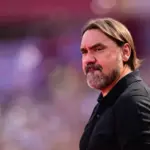
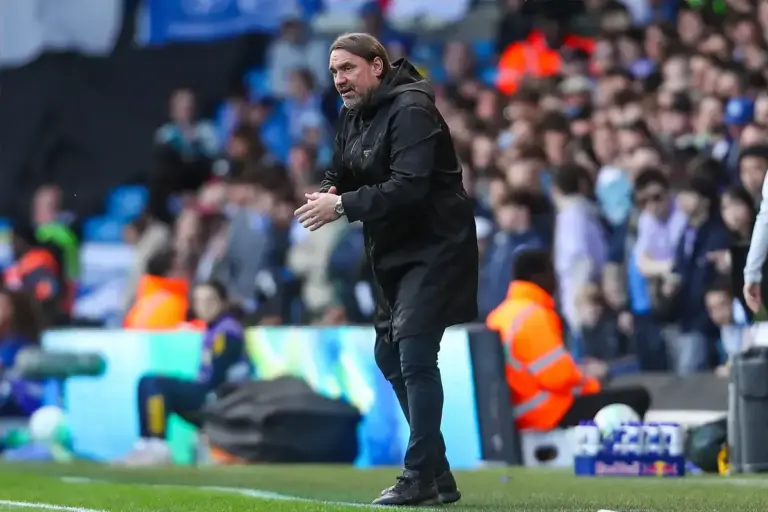
Daniel Farke is the manager of Leeds United, and by the standards of a club that got through a small army of them in the years before he arrived, he is something close to a fixture. He took the job in July 2023 with the Whites freshly relegated and a squad that needed dismantling. Three years on he has a Championship title, a 100-point season and Premier League survival on his record, and Leeds are into a second successive top-flight campaign under him. This is how he got here, and what he actually does.
Daniel Farke’s road to Elland Road
Born in Germany in October 1976, Farke was never a professional footballer of any note. He spent his playing career as a striker in the German lower leagues, most of it with SC Verl, the small Westphalian club where he later took his first serious job in management. He was appointed Verl manager in 2010 and won promotion with them, which was enough to earn him the role in charge of Borussia Dortmund’s second team in 2015 — the sort of post that is less about results than about proving you can coach young players in a demanding environment.
It worked. In 2017 Norwich City hired him, and the four years that followed made his name in England. Farke won the Championship title at Carrow Road in 2018/19 with a side built on almost no money, playing an insistent, possession-heavy style that acquired the nickname Farkeball. Norwich were relegated, and he won the Championship again in 2020/21. A poor start back in the Premier League cost him his job in November 2021.
What came next was brief and strange. He joined Russian club Krasnodar in late 2021 but left without taking charge of a competitive match. A single season at Borussia Mönchengladbach followed in 2022/23, after which he was available — at exactly the moment Leeds United needed someone to rebuild from the rubble of relegation.
What Farke has done at Leeds United
The 2023/24 season was, on the numbers, one of the better Leeds campaigns of the modern era that ended in nothing. Farke reassembled a gutted squad, got 90 points out of it, finished third and lost the play-off final to Southampton at Wembley. It is the season most Leeds supporters would rather not revisit, and it is also the season that established he could work.
The following year he removed the doubt. Leeds won the Championship in 2024/25 with 100 points, the kind of total that ends arguments, and went up as champions. Promotion is the easy part at Elland Road; staying up is not, and 2025/26 was a hard, unglamorous survival season that finished 14th. It was enough. Leeds went into 2026/27 as an established Premier League club for the first time in years, with Ethan Ampadu wearing the armband and a squad reshaped again over the summer.
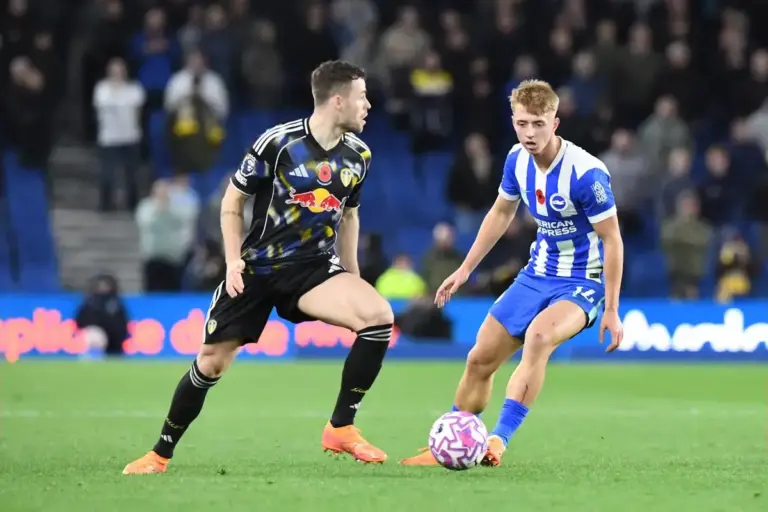
The start has been encouraging. Anton Stach’s free-kick won the league opener 1-0 at Nottingham Forest on 22 August, and Leeds went back to the City Ground three nights later and won 2-0 in the EFL Cup second round. Two competitive games, two wins, no goals conceded. Our player ratings from the opening win at Forest cover how the individual performances landed.
How his Leeds teams play
Farke is a 4-2-3-1 manager who wants the ball. His sides build patiently from the goalkeeper, use full-backs high and wide, and rely on a double pivot in midfield to recycle possession rather than to smash through it. The centre-forward is asked to occupy defenders and hold the middle of a back four while wide players attack the byline and the No.10 arrives late in the box. It is a structure, not a set of instructions, and it takes time to bed in — which is why his first months at a club are usually worse than his last.
In the Premier League that approach has been adapted rather than abandoned. Leeds sit deeper, press in a more organised block and are considerably more comfortable without the ball than his Norwich sides ever were. What has not changed is his instinct for developing players. Farke’s record of improving footballers other clubs had given up on — and of trusting younger players when the alternative is a panic signing — is the most consistent thread running through his career.
The manner of the man
Anyone who watches a Farke press conference knows the register: courteous, wordy, faintly amused, and almost impossible to move off a prepared position. He does not confirm transfers before they are signed, he does not publicly criticise individual players, and he has an unusually high tolerance for questions he has already answered four times. In a job where the temperature at Elland Road can rise very quickly, that flatness of tone has been an asset rather than a limitation.
It also means the interesting Farke material tends to arrive obliquely — a phrase about squad depth that turns out to have been a hint, or a shrug about a goalkeeper that becomes a signing a week later. Official squad and staff details are maintained on the Leeds United website, and his day-to-day dealings with the press are covered closely by the Yorkshire Evening Post.
Why he matters now
Leeds have spent much of the last decade searching for a manager who could survive contact with the club’s own expectations. Marcelo Bielsa gave them an identity and a promotion, then ran out of road. Several of the men who followed him lasted months. Farke has now been in post for three years across three divisions’ worth of pressure, and the club’s rebuild — James Trafford in goal, Tarik Muharemović and Nico Elvedi added to the back line, Harry Wilson brought in on a free — has been built around what he wants rather than around what happened to be available.
That is the real measure of his standing at Elland Road. Leeds are not assembling a squad and hoping a manager fits it. They are assembling one for him. Our confirmed 2026/27 squad numbers show the shape of it.