Ask who owns Leeds United and you will get a different answer depending on which decade the person you are asking last paid attention. The Whites have had five separate ownership groups in twenty years, a spell in administration, a stadium sold from under them and a sponsorship deal that a lot of neutrals still mistake for a takeover. Here is the current picture, clearly laid out, along with how the club got here.
Who owns Leeds United right now?
Leeds United are owned by 49ers Enterprises, the investment arm of the San Francisco 49ers of the NFL. It is not a personal ownership in the mould of a single billionaire proprietor; it is the commercial and investment vehicle of an American sports franchise, and Leeds is its flagship holding outside gridiron.
The chairman of Leeds United is Paraag Marathe, who is also president of 49ers Enterprises and a long-serving executive at the San Francisco club. He is the figure supporters see most often in the directors’ box and the one who fronts strategy on recruitment, infrastructure and the stadium.
Alongside the controlling group sits a set of minority investors drawn largely from American sport, including golfer Jordan Spieth. Their stakes are small and passive; day-to-day control rests with 49ers Enterprises.
How 49ers Enterprises took over at Elland Road
This was one of the slowest takeovers in modern English football, and deliberately so. The sequence ran roughly like this:
- 2018 — 49ers Enterprises bought an initial minority stake in Leeds from then-owner Andrea Radrizzani, buying in while the club was still a Championship side.
- 2021 — the American group increased its holding substantially and secured a pathway to full control, with an agreed option to buy out Radrizzani.
- July 2023 — following relegation from the Premier League, 49ers Enterprises exercised that option and completed a full takeover, with Radrizzani departing to focus on Sampdoria.
The valuation attached to the deal was widely reported at around £170m, though the club has never confirmed a figure publicly. The important structural point is that the buyers already knew the business inside out: they had held board seats for five years before taking the keys.
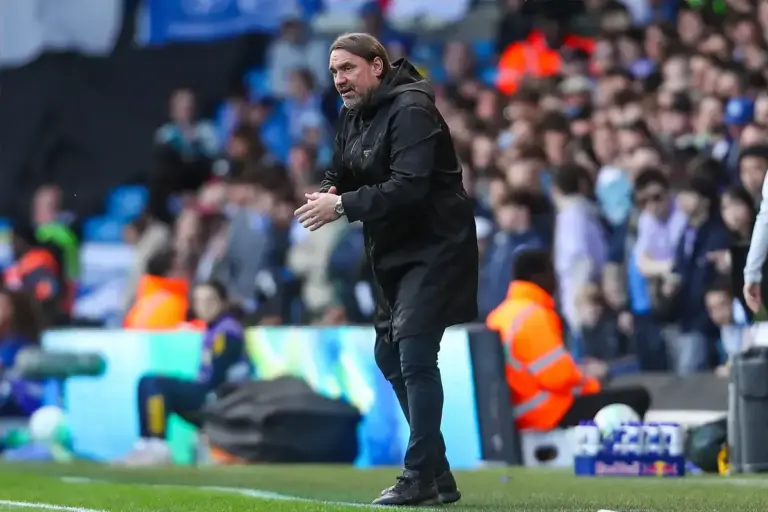
What followed was promotion as Championship champions in 2024/25 and a 14th-placed finish in 2025/26 that secured Premier League survival. Marathe remains chairman heading into a second successive top-flight campaign under Daniel Farke — our piece on Marathe’s wider role across the 49ers Enterprises portfolio covers where Leeds sits among the group’s other football interests.
No, Red Bull do not own Leeds United
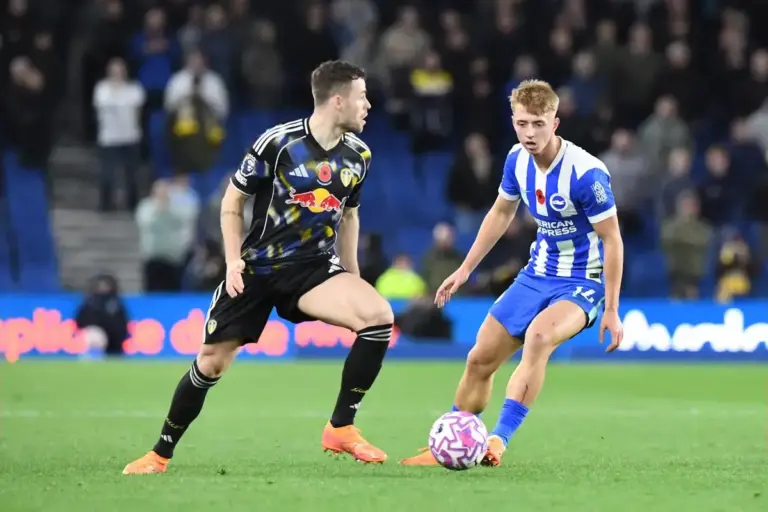
This is the single most common misunderstanding about the club’s ownership, and it is worth being blunt about. Red Bull are a commercial partner and shirt sponsor of Leeds United. They are not the owners.
The confusion is understandable. Red Bull’s involvement in football elsewhere — RB Leipzig, Red Bull Salzburg, New York Red Bulls, Red Bull Bragantino — is ownership, and those clubs carry the brand in their names. At Elland Road the relationship is a partnership arrangement rather than control. Leeds United are still Leeds United, the badge is unchanged, the name is unchanged, and 49ers Enterprises remain the owners. Anyone telling you the Whites have joined a Red Bull group of clubs has the wrong end of it.
Who owned Leeds United before?
The modern ownership history is a short course in how a big club can be knocked about:
- Peter Ridsdale era (1997–2003) — the chairmanship that produced the Champions League semi-final run of 2001 and, when the borrowing caught up with the club, the fire sale that followed relegation in 2004.
- Ken Bates (2005–2012) — took charge after the club emerged from its financial collapse, oversaw the years in League One and the return to the Championship, then sold to GFH Capital.
- GFH Capital (2012–2014) — the Bahrain-based investment firm whose ownership was short and turbulent.
- Massimo Cellino (2014–2017) — the Italian businessman, previously of Cagliari, whose tenure featured repeated managerial changes and disputes with the Football League.
- Andrea Radrizzani (2017–2023) — bought out Cellino, appointed Marcelo Bielsa, ended the 16-year exile from the Premier League in 2020, then sold to 49ers Enterprises.
Who owns Elland Road?
A separate question, and for years a sore one. Elland Road was sold off in 2004 during the financial crisis that engulfed the club, leaving Leeds as tenants in their own ground and paying rent on it for well over a decade.
Radrizzani bought the freehold back in 2017, returning the stadium to club ownership. That mattered enormously to supporters at the time and it matters commercially now, because it is what makes redevelopment possible. Under 49ers Enterprises the club has pushed on with plans to expand capacity at Elland Road, with the North Stand and the Kop the focus of the long-term work.
What the ownership model actually means for Leeds
Three practical consequences are worth understanding.
First, it is institutional rather than personal. Decisions run through a board and an executive structure rather than one individual’s whim, which tends to mean slower moves and fewer sackings, but also less appetite for a sudden reckless splurge.
Second, the American sports influence is real. Data-led recruitment, an emphasis on matchday revenue and stadium infrastructure, and a focus on the club’s commercial reach beyond Yorkshire are all recognisable 49ers Enterprises hallmarks.
Third, Premier League financial rules apply regardless. Whoever owns a club, spending is governed by the league’s profitability and sustainability rules, the framework for which is published by the Premier League itself. A wealthy owner cannot simply write cheques, which is why Leeds have balanced this summer’s incomings with sales.
The short answer
Leeds United are owned by 49ers Enterprises, chaired by Paraag Marathe, having completed a full takeover in July 2023 after five years as minority shareholders. The club owns Elland Road outright. Red Bull are sponsors, not owners. Corporate details and the current board are listed on the official Leeds United website.
After two decades of upheaval, the notable thing about the current arrangement is how unremarkable it has been — and at Elland Road, that counts as progress.